
Water Damage Restoration Cost Guide: What Midtown Manhattan Homeowners Pay in 2026
Water damage restoration in Midtown Manhattan typically runs $4,200 to $21,000 in 2026, depending on the water category, affected materials, and building restrictions. The national average of $1,200 to $5,000 rarely applies here. If you’d rather not sort through variables yourself, call (518) 314-5660 for a straight answer from a live person.
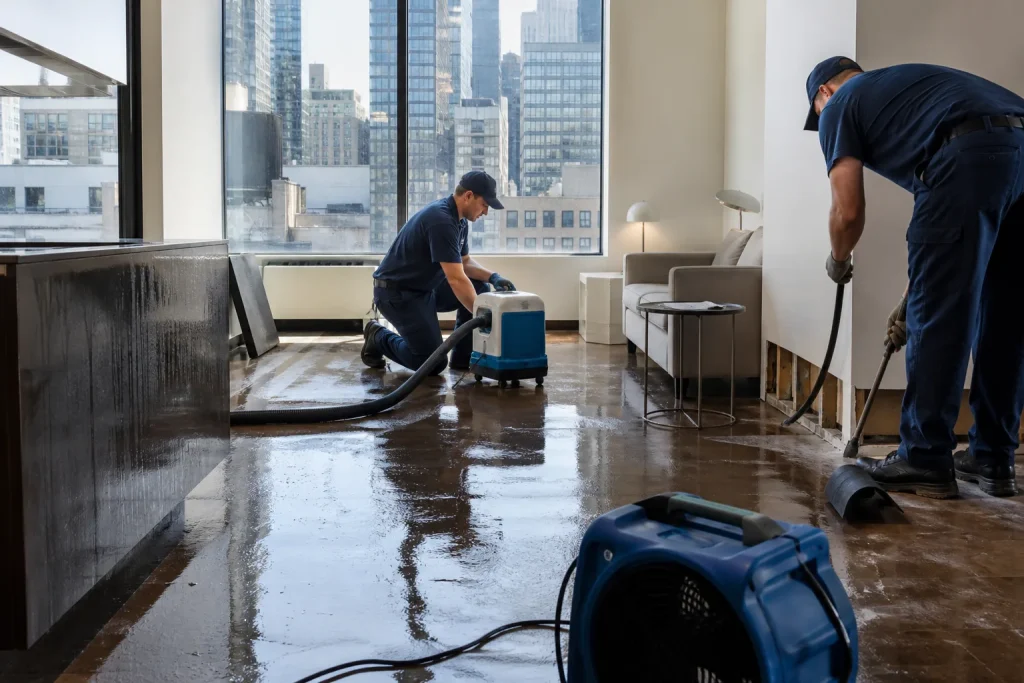
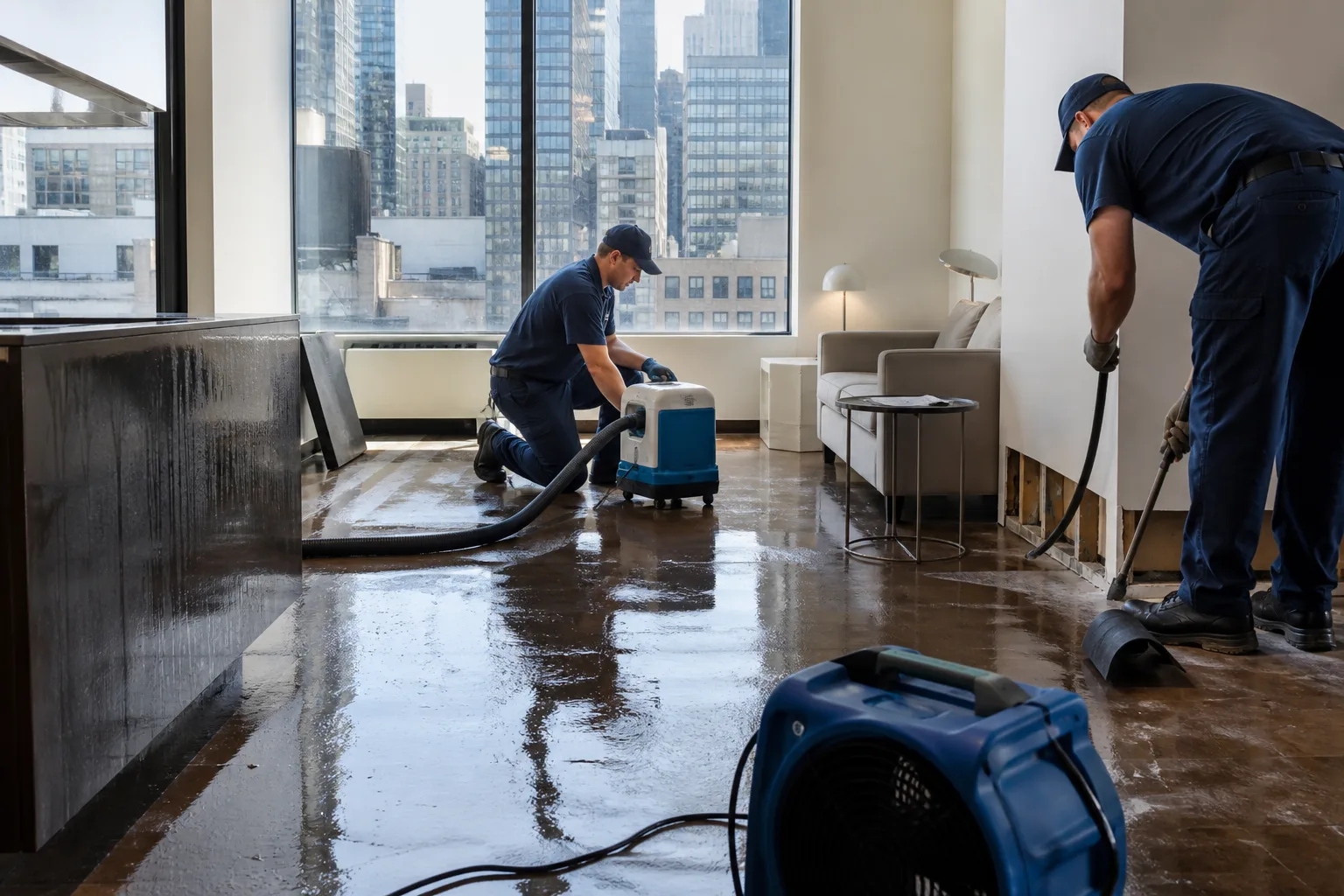
We pulled a Category 2 job out of a prewar co-op on West 54th last month. The water had been sitting in a hardwood hallway for six hours, and the board required a COI filed 48 hours before we could even park a fan. The extraction took three hours. The paperwork took three days. That’s Midtown.
The numbers most cost guides publish are built for single-family homes with a driveway, a basement, and no board approval. A Midtown Manhattan address changes the math before a single piece of equipment comes off the truck. This guide breaks down what actually drives your bill, how to read a quote, and where contractors try to hide gaps.
The Five Midtown-Specific Cost Drivers Most Guides Never Mention
If you live in a Midtown Manhattan co-op, condo, or rental building, your restoration cost isn’t just labor plus materials. It’s labor plus materials plus five variables that suburban cost guides ignore entirely.
- Co-op and condo board access restrictions. Many Midtown buildings require contractors to file a certificate of insurance (COI) naming the board and managing agent as additional insureds, using their exact legal wording. That filing takes 24 to 48 hours in most buildings. Every hour of delay is another hour of water wicking into plaster and subfloor, which means a bigger drying perimeter and a bigger bill. Some buildings also demand advance notice for any truck parking, elevator use, or noise-producing work.
- Freight elevator fees and hours. East Side and West Side high-rises typically allow contractor use only of the freight elevator, often restricted to 9 a.m. to 4 p.m., with a required reservation and a per-load fee that can run $50 to $150 per round trip. A Category 3 sewage job can generate a dozen equipment trips before drying even starts. Those charges are real and they’re on your scope if the contractor knows to include them. If they don’t know, they’ll surprise you later or eat it and cut corners.
- Lead and asbestos testing in pre-1978 buildings. Most of Midtown’s residential stock was built before 1978. If water damage exposes plaster, pipe insulation, or flooring that may contain lead or asbestos, New York City regulations require testing before demolition or material removal. A lead paint test adds $300 to $600. Asbestos sampling and lab analysis can add $500 to $1,500 depending on how many materials are suspect. Contractors who skip this step in their estimate are either novices or planning to skip the test entirely, which is illegal.
- After-hours work mandates. Some boards only allow noisy work between midnight and 6 a.m. to avoid disrupting building residents during business hours. Other buildings prohibit it entirely after 6 p.m., which means a three-day drying project might need a one-day extension. After-hours labor in Midtown runs time-and-a-half to double-time, which adds $800 to $2,500 to a typical job.
- Direct insurance billing versus out-of-pocket. Insurance carriers in New York City pay on their own schedule, typically 30 to 60 days after an approved scope. Contractors who bill carriers directly carry their own cash flow through that gap. Smaller shops can’t afford to, so they ask you to pay upfront and chase your own reimbursement. That’s not dishonest, but it changes what “out of pocket” means for you. Floodline Restoration Co. bills carriers directly so you’re never playing messenger.
Real Cost Breakdown by Water Category and Material in Midtown Manhattan
Water category determines the level of containment, personal protective equipment, and disposal required. Your material determines how much has to be removed versus dried in place. Both affect the price.
Category 1: Clean Water
This is water from a supply line, a toilet tank, or a faucet left running. No sewage, no ground seepage. In a Midtown Manhattan apartment, you’re looking at $75 to $95 per labor hour plus equipment.
| Material | Typical Midtown Cost Range | Notes |
|---|---|---|
| Hardwood strip flooring | $900-$2,800 per room | Often salvageable with Injectidry panel drying if caught within 24 hours |
| Plaster walls | $600-$1,800 per wall | Thick prewar plaster dries slowly; often requires wall cavity injection |
| Drywall | $500-$1,200 per wall | Usually demoed if saturated; replacement included in rebuild scope |
| Concrete slab | $1,500-$4,500 per unit | High-rise slabs retain moisture for weeks without proper airflow |
| Carpet | $350-$800 per room | Usually removed and replaced unless dry within 48 hours |
Category 2: Gray Water
This is water from washing machines, dishwashers, or aquarium leaks. It carries microorganisms but not sewage. Midtown pricing runs 15 to 25 percent higher than Category 1 because of antimicrobial treatment and containment.
Full-scope Category 2 restoration in a Midtown apartment, including extraction, containment, drying, daily monitoring, and basic rebuild of drywall and trim, typically lands between $7,000 and $15,000.
Category 3: Sewage and Floodwater
This is the expensive one. Sewage backup or river water entering a below-grade Midtown space requires full containment, negative air pressure, HEPA filtration, and disposal of every porous material touched. Labor rates hold but the material removal list gets long.
A Category 3 kitchen or bathroom in a Midtown co-op commonly runs $12,000 to $28,000 before any significant rebuild. Add lead or asbestos abatement, which is common in older buildings, and the range extends to $35,000. This is where insurance scopes get contested word by word.
We’ve used Dri-Eaz dehumidifiers, Phoenix air movers, XPOWER axial fans, and B-Air units on these jobs. The equipment matters less than the moisture map and the daily log. A contractor who can’t hand your adjuster a day-by-day drying record is not going to convince them to pay for what was actually done.
Why Splitting Extraction and Rebuild Adds 20-35% to Your Total
Most national water damage franchises in New York City do not rebuild. They extract, dry, and hand you a list of contractors who can hang drywall and refinish floors. That handoff is where costs compound.
Here’s the math. The drying contractor leaves. You call a general contractor. The GC needs their own COI approval from the board, their own site visit, their own submittal to your carrier, and their own schedule. The drying contractor already removed baseboard and drywall before drying. The GC has to reconstruct from someone else’s demolition line, which means extra measurement time, extra assumptions, and extra contingency in their bid. The GC also has no incentive to honor the drying contractor’s guarantee because they never touched that phase.
In our experience across Midtown Manhattan, the two-contractor path reliably adds 20 to 35 percent to total project cost. Some of that is pure time. Some is the GC’s defensive pricing because they can’t see what’s behind the wall.
A single firm that handles extraction, drying, and rebuild with the same certified technicians writes one scope, files one COI, and carries one warranty. That’s what Floodline Restoration Co. does. We start at the floodline, the honest mark the water left, and we don’t hand the job off until the finish trim is up and the paint is dry.
Related services in Midtown Manhattan: Water Damage Restoration in Midtown Manhattan | Mold Remediation in Midtown Manhattan | Fire & Smoke Damage Restoration in Midtown Manhattan
How to Read an Insurance Scope of Loss in a Dense Urban Market
Your carrier’s adjuster writes a scope of loss using estimating software loaded with national pricing. National pricing doesn’t know your board requires $175 freight elevator round trips. It doesn’t know your building mandates after-hours work. It doesn’t know your co-op’s COI demands take 48 hours.
Here are the line items consistently underfunded on Midtown Manhattan water damage claims:
- Elevator and freight fees. Many scopes include zero line item for this. A typical high-rise job loses $600 to $2,000 here alone.
- Containment and negative air. National software prices this for suburban room sizes. Midtown apartments often require zippered containment in tight hallways and through elevator lobbies, which takes longer and costs more.
- Daily monitoring visits. Carriers routinely approve three visits for a drying job that needs seven or eight. Every monitoring visit in a Midtown building involves freight elevator scheduling and sometimes a building security escort. Your restoration contractor should document each visit and push back with dated moisture readings.
- Lead and asbestos testing. Carriers often omit it entirely from the initial scope, then argue it’s “maintenance” when it appears as a supplemental. Your contractor has to classify it correctly as demolition-related testing.
- City permit fees. If structural drying requires opening walls or floors in a landmarked building, the Landmarks Preservation Commission may require a permit. Most scopes never include the filing time or the fee.
A restoration company that bills carriers directly, as we do at Floodline Restoration Co., fights these line items with photo documentation, daily logs, and a written scope before work starts. You should never be the one calling your adjuster to explain why a freight elevator costs money.
The One Question That Exposes a Lowball Bid
Ask every bidder this: “Does your price dry the structure to the IICRC dry standard and rebuild what you remove, or does it just get the job substantially complete?”
Watch their face when you ask.
“Substantially complete” is the escape hatch. It means the contractor’s scope ends when visible water is gone, not when the moisture meter says the slab is back to its pre-loss reading. In a Midtown apartment with a concrete slab under your hardwood, visible dryness can happen days before structural dryness. If they stop early, you get warped floors, hidden mold behind the baseboard, and a musty smell that comes back in July when the humidity rises.
Our technicians are trained to IICRC, RIA, and IFA standards. We moisture-map every affected room on day one, take daily readings with a log we hand to you and your carrier, and we don’t call a structure dry until the numbers say dry. Not until the floor feels dry to the touch.
A “substantially complete” bid is also where rebuild gaps hide. If the quote includes extraction and drying but no line item for drywall replacement, trim, paint, and finish work, it’s not a complete number. It’s a stripped number designed to look cheaper on the first call. Add the rebuild later and the real cost shows up after you’ve already signed.
What Fair Pricing Looks Like in 2026
Fair pricing in Midtown Manhattan reflects the variables above. A Category 1 supply line burst in a modern luxury rental with no board restrictions and quick access should cost you $4,000 to $8,000. A Category 3 sewage event in a postwar co-op with pre-1978 plaster, a freight elevator, and after-hours rules should cost $18,000 to $30,000, with testing and rebuild properly itemized.
A square deal doesn’t mean the cheapest number. It means a number that’s complete, explained, and committed in writing. We’ve been doing this in New York City since Curt Bowman founded Floodline Restoration Co. in 2010, and the jobs that come to us from other contractors’ half-finished work cost more than the jobs we start on day one.
When to call a pro: if water touched drywall, plaster, finished flooring, or anything below grade, call a professional. The first 24 hours determine whether you’re drying or rebuilding. A dehumidifier from the hardware store won’t dry a wall cavity or a concrete slab in a Midtown high-rise. And if the water contains sewage, you should not be in the room without protective gear at all.
The Bottom Line
Water damage restoration in Midtown Manhattan runs $4,200 to $21,000 in 2026, pushed higher by building restrictions, prewar materials, and water category. The cost drivers are predictable if you know to ask about elevator fees, COI requirements, lead and asbestos testing, after-hours mandates, and how a contractor handles insurance billing. A bid that’s 20 percent cheaper often excludes the rebuild or ends at “substantially complete,” which is neither dry nor done.
If you’re in Midtown Manhattan and need a straight answer about water damage, call Floodline Restoration Co. at (518) 314-5660. A live dispatcher answers, every time, at any hour. We’ll walk your building’s specific constraints, give you a written scope before work starts, and stand behind the result with our 90-Day Done Right Promise. That’s the Keystone Standard: if it’s not done right, we make it right. No arguing, no paperwork battles.
We also offer $50 off any repair over $250, an $89 seasonal tune-up, and a standing 5 percent discount for seniors and veterans. The line the water left is where we start. We’ll be there when we say.
Frequently Asked Questions
Water damage restoration in Midtown Manhattan typically costs $4,200 to $21,000 in 2026, depending on water category, affected materials, and building access restrictions. Category 1 clean water jobs start around $4,000, while Category 3 sewage jobs in prewar buildings can exceed $30,000 with testing and rebuild included. Call (518) 314-5660 for a free, written estimate specific to your building.
Most homeowner and co-op policies cover sudden and accidental water damage, but coverage depends on the source. Supply line bursts and appliance failures are typically covered. Sewage backup often requires a separate endorsement. Gradual leaks, which carriers call “long-term seepage,” are frequently denied. A restoration company that bills carriers directly can submit photo documentation and daily moisture logs that strengthen your claim. Floodline Restoration Co. handles direct insurance billing so you don’t chase your own reimbursement.
Floodline Restoration Co. runs live dispatch 24 hours a day, 7 days a week. A certified crew reaches your Midtown Manhattan address the same visit when you call, with extraction equipment ready. Board-mandated COI filings may add 24 to 48 hours before certain buildings allow entry, so call as soon as you see water. The faster extraction starts, the less material gets removed and the lower your total cost.
If water touched drywall, plaster, flooring, or anything below the surface, you need professional drying with moisture measurement. A hardware store fan dries the air, not the wall cavity or the concrete slab underneath your floor. Materials left wet behind walls grow mold within 48 to 72 hours. The IICRC dry standard exists because visible dryness is not structural dryness. For a small, contained clean water spill on tile with no wall contact, a mop and open windows may handle it. Anything more, call a pro.
Written by Curt Bowman, Owner at Floodline Restoration Co., serving Midtown Manhattan since 2010.
Need Damage Restoration Help?
Call Floodline Restoration Co. - licensed & insured, here with fast after-hours help in Midtown Manhattan.
(518) 314-5660